Start with a small Java class:
public class Example {
    private String name;

    public String value() {
        return name.toUpperCase();
    }
}
At the Java level, value() reads the field name, calls String.toUpperCase(), and returns the result. The names make the code easy to follow.
Now compile it and ask javap to show the class file in detail:
javac Example.java
javap -v Example.class
Inside the output, the bytecode for value() looks like this:
0: aload_0
1: getfield      #7
4: invokevirtual #13
7: areturn
javap also prints a comment after each numbered instruction that summarizes the selected pool entry. We will build those comments ourselves by following the entries.
You do not need to understand every instruction yet. Look first at the two numbered references:
getfield      #7
invokevirtual #13
What are #7 and #13? They are not source line numbers, object offsets, or memory addresses. Each number selects an entry in Example.class’s constant pool.
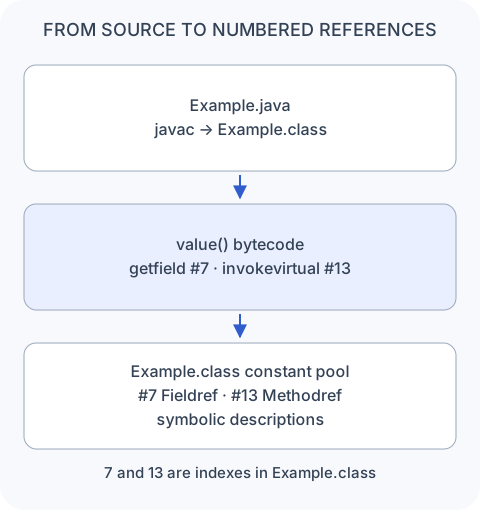
Lesson 10 showed how class-file bytes become a live JVM class. This lesson opens those bytes and explains the numbered table that connects portable bytecode to runtime classes, fields, and methods.
Read the numbers in javap output
Three kinds of numbers appear in the relevant javap -v output. They mean different things:
1: getfield #7
↑           ↑
bytecode    pool
offset      index
The bytecode offset tells us where an instruction begins in the method’s bytecode array. The number after # tells the instruction which constant-pool entry to use.
The pool itself contains these entries:
 #7 = Fieldref      #8.#9
 #8 = Class         #10
 #9 = NameAndType   #11:#12
#10 = Utf8          Example
#11 = Utf8          name
#12 = Utf8          Ljava/lang/String;

#13 = Methodref     #14.#15
#14 = Class         #16
#15 = NameAndType   #17:#18
#16 = Utf8          java/lang/String
#17 = Utf8          toUpperCase
#18 = Utf8          ()Ljava/lang/String;
Here #8.#9 is another lookup: entry #7 points to entries #8 and #9. Those entries point to more entries. The constant pool is a numbered table whose rows can refer to other rows.
Follow entry #13:
#13 Methodref
  ├── #14 Class
  │     └── #16 Utf8 → java/lang/String
  │
  └── #15 NameAndType
        ├── #17 Utf8 → toUpperCase
        └── #18 Utf8 → ()Ljava/lang/String;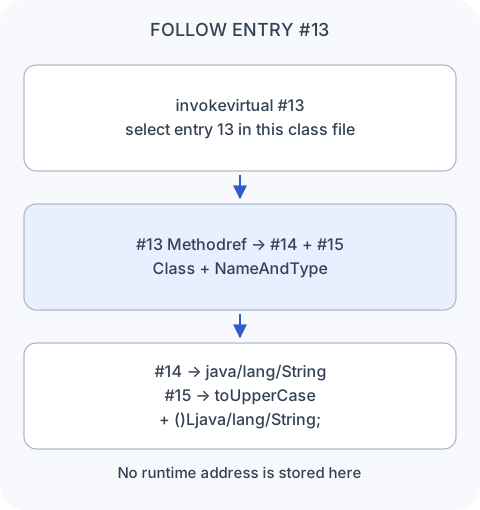
The comment printed by javap is a readable summary of that chain. Formatted across lines, its three pieces are:
class:      java/lang/String
method:     toUpperCase
descriptor: ()Ljava/lang/String;
In the actual output, javap prints those pieces together after // Method. The class file stores the structured entries; javap follows them and creates the helpful comment for us.
A constant-pool index belongs to one class file
Every class file has its own constant pool. In Example.class, #13 means the method reference we just followed. In an unrelated Customer.class, #13 could be a string, a number, a field reference, or another method reference.
The index only has meaning together with the class file that owns the pool:
Example.class
    + #13
       │
       └── String.toUpperCase()
Recompiling the same source can also change the indexes because adding or removing entries can rearrange the table. Code should never attach meaning to a particular number such as 13. The entry’s contents carry the meaning.
This gives us the first mental model:
bytecode operand #n
        │
        ▼
entry n in this class file's constant pool
        │
        ▼
constant or symbolic description
The pool contains more than literal constants
The name constant pool can suggest a list containing only values such as 42 or "hello". It also contains the vocabulary that a class file uses to describe other parts of the program.
A useful grouping is:
class-file constant pool

├── literal values
│   ├── integers and floating-point values
│   └── strings
│
├── symbolic references
│   ├── classes and interfaces
│   ├── fields
│   ├── class methods
│   └── interface methods
│
└── supporting structure
    ├── names and descriptors
    ├── method handles and method types
    └── dynamic invocation data
At the class-file level, these categories use entry kinds such as CONSTANT_Class, CONSTANT_Fieldref, CONSTANT_Methodref, CONSTANT_String, and CONSTANT_Integer. CONSTANT_NameAndType and CONSTANT_Utf8 supply the names and type descriptions used by other entries.
You do not need to memorize the entry-kind list. You need to be able to look at an instruction such as invokevirtual #13, find entry 13, and follow its references until the target becomes readable.
Not every bytecode operand is a pool index. In aload_0, the 0 identifies a local-variable slot. In 1: getfield #7, 1 is a bytecode offset and #7 is a pool index. The syntax and instruction definition tell you which kind of number you are reading.
Follow the method call through the pool
We can now return to the Java expression that began the lesson:
name.toUpperCase()The compiler emits invokevirtual #13. Entry 13 describes three pieces of information:
reference class: java/lang/String
method name:     toUpperCase
descriptor:      ()Ljava/lang/String;
The descriptor records the parameter and return types. Here () means that this method takes no explicit arguments, and Ljava/lang/String; means that it returns a reference to java.lang.String.
The class named in a method reference is the reference class, where method lookup begins. The method can ultimately be inherited rather than declared directly in that class. The symbolic reference gives the JVM enough information to perform the specified lookup; it does not contain a final machine-code address.
The field instruction works the same way at this level. getfield #7 leads to:
reference class: Example
field name:      name
descriptor:      Ljava/lang/String;
The instruction and the entry have separate jobs. getfield means “read an instance field from an object reference.” Entry #7 identifies which field.
Symbols make separate compilation possible
Example can be compiled against the available String API without running the eventual application. Later, a class loader supplies the deployed runtime type and the JVM connects String.toUpperCase() to that live type. This supports separate compilation and dynamic loading without embedding the future process’s addresses.
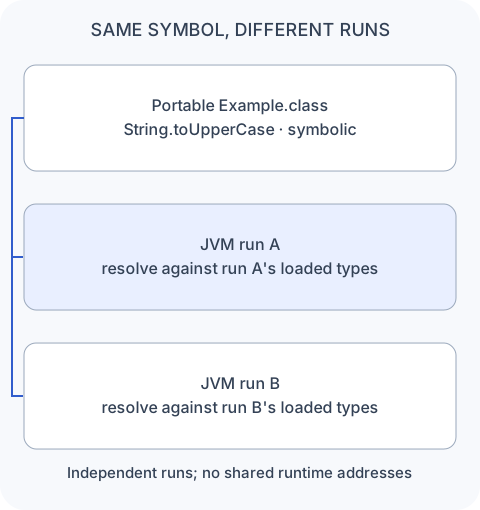
A compatible class file can be used across different JVM implementations, architectures, and process runs because each runtime supplies its own representation. Compatibility still matters: the runtime must support the class-file version and provide the required dependencies. Symbols defer binding; they do not make an incompatible library compatible.
The class-file pool and runtime pool are distinct
On disk, constant_pool is a table in the class-file format. During creation of a class or interface, the JVM constructs its runtime constant pool from that information. There is a runtime constant pool for each runtime class or interface, rather than one global pool shared by the application.
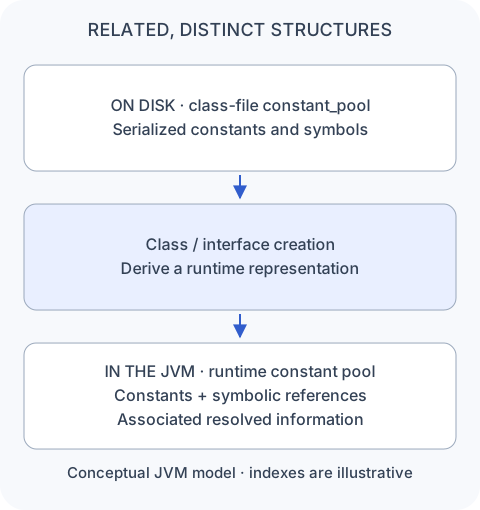
The runtime pool has static constants and symbolic references that may later be resolved. Runtime information can be associated with resolved references. It is not a byte-for-byte copy of the serialized table: descriptive entries such as NameAndType and Utf8 contribute indirectly to runtime references. Nor is it the string-intern pool; string constants are only one part of the model.
HotSpot builds implementation-specific structures for execution. The specification defines their meaning without requiring a particular memory layout or a literal pointer in each entry. Resolving a reference does not rewrite the .class file on disk.
Resolution connects symbols to live runtime entities
The class file has told us which member it needs:
class:  java/lang/String
method: toUpperCase
type:   ()Ljava/lang/String;
Before the runtime can use that relationship, the JVM has to connect the symbol to the live types and members in this process. That work is called resolution.
At a high level, method resolution answers four questions:
- Which runtime
java.lang.Stringtype does this name identify? - Does method lookup find
toUpperCasewith the recorded descriptor? - Is the access permitted?
- If those checks succeed, what runtime method relationship represents the result?
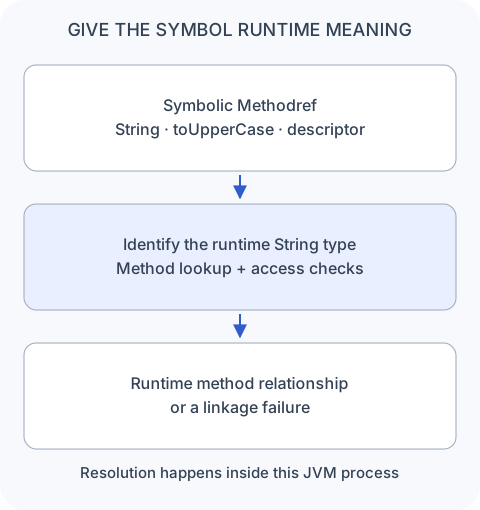
Class-loader identity remains part of the first question. Class resolution uses the defining loader of the referring class to initiate loading of the named type. Delegation may lead another loader to define java.lang.String. Runtime identity still depends on the binary name and defining loader, as we saw in Lesson 10.
Two independently defined classes with the same name are not interchangeable merely because their names match. Loader constraints help keep types in member signatures consistent across these relationships. Conversely, two child loaders delegating to the same parent definition can share a type. Field resolution follows its own lookup rules, and instruction-specific checks also matter, such as whether a field access expects a static or instance field.
Successful resolution lets the JVM reuse the established relationship instead of repeating symbolic lookup for every execution. The exact representation of cached execution information is an implementation choice.
Resolution is not virtual dispatch
Suppose PremiumCustomer extends Customer and overrides getName:
Customer customer = new PremiumCustomer();
String name = customer.getName();
The bytecode can reference Customer.getName. Resolving that reference does not permanently choose Customer’s implementation for all receivers. For this ordinary virtual call, method selection uses the receiver’s runtime class and the resolved method relationship, so the override in PremiumCustomer executes.
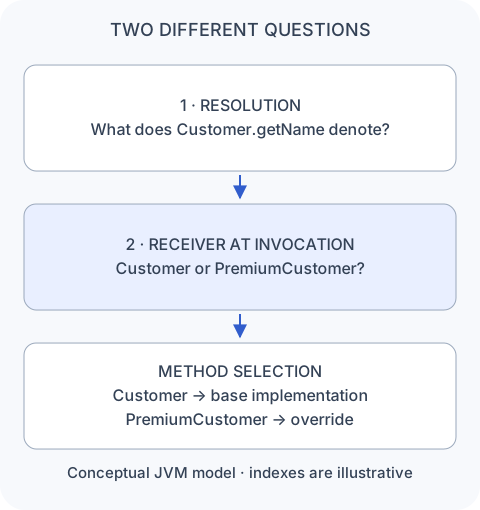
Keep the two questions separate: resolution establishes what member the symbolic reference denotes; dispatch selects the applicable implementation for this receiver. Another call through the same resolved reference can receive an ordinary Customer. A JIT can optimize dispatch when its assumptions permit, while preserving Java’s required behavior.
Resolution may be lazy
An initialized class can still have unresolved references. A JVM may resolve references eagerly or defer work until needed, within the specification’s rules for when errors become observable. “Everything resolved before initialization” is therefore too strong, but “every reference always resolves at first use” is also too strong.
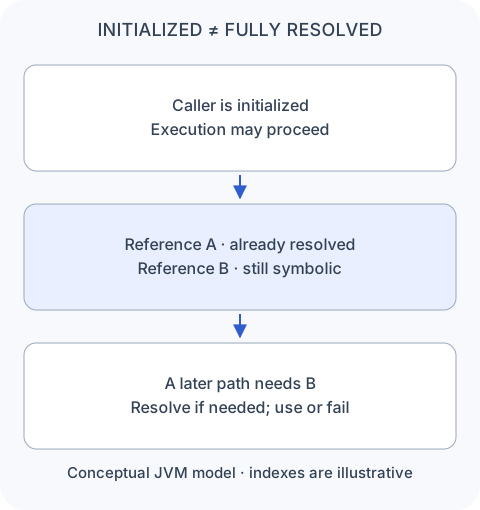
Deferring work can avoid resolving unused paths and move some cost to first use. This helps explain why a rarely used endpoint can reveal a missing dependency long after startup. A successful health check only exercises the paths it actually reaches; it does not establish that every symbolic reference in the application is satisfiable.
Field access does not encode object offsets
Return to getfield #7. Entry 7 identifies Example.name with descriptor Ljava/lang/String;. It does not say “read eight bytes at physical object offset 24.” The pool describes which field is intended; the running JVM determines how to access it in its chosen object representation.
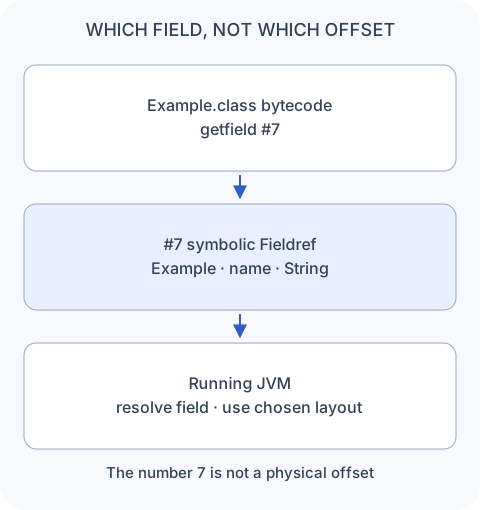
HotSpot may use field offsets internally, and generated machine code may incorporate layout information. That is a runtime implementation detail, not the meaning of the class-file operand.
Keep these three numbers apart:
1      → bytecode offset
#7     → constant-pool index
layout → chosen by the runtime
The javap command examines the class file. It does not display the running JVM’s resolved metadata, a field’s runtime offset, or the moment resolution happens.
The interpreter combines metadata with operands
The example also reveals the next layer of execution. Each invocation has a frame with local variables, an operand stack, and access to the runtime constant pool of the current method’s class. The receiver and values live in the frame’s execution state; symbols identify the members used by instructions.
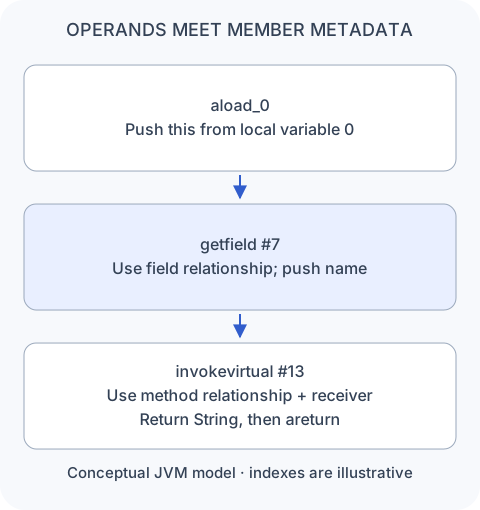
In value(), aload_0 pushes this. getfield #7 consumes that object reference and pushes the name reference. invokevirtual #13 consumes the String receiver, selects and invokes the method, and supplies its returned String reference. areturn returns that reference to the caller. If name is null, invocation fails with NullPointerException; successful resolution does not guarantee valid operands.
This describes bytecode semantics and the interpreter’s conceptual inputs. It does not require HotSpot to redo a full symbolic search on every instruction, nor mean all methods must be interpreted before compilation.
A deployed library can break a symbolic relationship
Now consider a production failure. The application was compiled against a library supplying Library.foo:()V. At deployment, the selected version no longer supplies that method, including through the applicable inheritance lookup. The caller still contains the original symbolic reference, so resolving it fails with NoSuchMethodError.
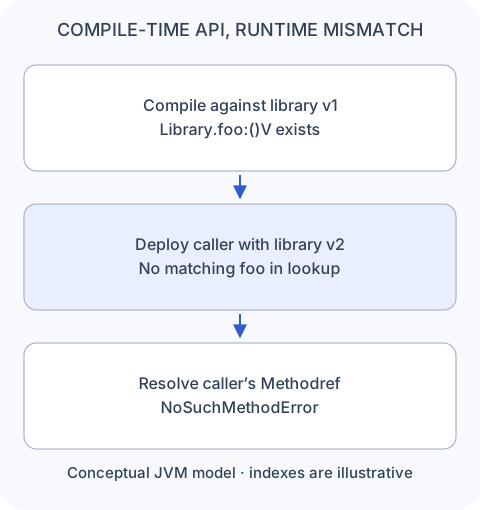
A removed field, or a changed field descriptor that leaves no matching field, can similarly produce NoSuchFieldError. These are member linkage failures. Check the exact owner, name, and descriptor in the error and caller’s javap output, then compare them with the actual deployed classes. Inspect dependency selection, duplicate JARs, and the defining loaders involved; the build-time dependency tree alone may not describe deployment.
ClassNotFoundException and NoClassDefFoundError are related but distinct. The former commonly comes from explicit name-based loading APIs when a requested class cannot be found. The latter is a linkage error that can surface when a required class definition cannot be obtained, including during resolution. It can also follow a failed class initialization; inspect the earlier cause. Neither is an interchangeable name for a missing method or field.
Check your reasoning
One call site has successfully resolved Customer.getName. A later call receives a PremiumCustomer that overrides it. Must it execute the base implementation? And does successful initialization of the caller prove that its unused field references will resolve?
Pause here, then check your reasoning
No to both. Resolution establishes the method relationship, while virtual selection still depends on the receiver, so the overriding method can execute. Initialization does not require all symbolic references to have been resolved. An unused reference can still expose a linkage failure when a later path needs it.
Now suppose getfield #7 appears in two unrelated class files. Must both instructions access the same field or offset?
Check what the index identifies
No. Each operand identifies an entry in its containing class's pool. Those entries may describe different fields, and neither index encodes a physical object offset.
From portable symbols to executing instructions
The class file supplies instructions and symbolic relationships. Loading constructs the live class representation, and resolution connects its references to runtime entities as required. Execution then combines those relationships with actual receivers and values.
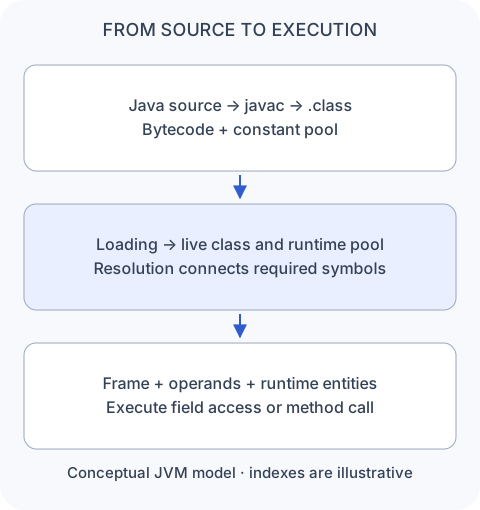
The next lesson follows stack frames, local variables, and the operand stack: where method arguments and intermediate values live, and how the interpreter executes a method instruction by instruction before we explore optimized execution.
Sources and implementation boundaries
Adapted from Daily JVM Byte #11 and the available reviewed draft. Diagrams and pool indexes outside the javap exercise are illustrative. The compilation and disassembly exercise was verified on Homebrew OpenJDK HotSpot 25.0.2; deployment failures are reasoning examples. JVM rules are distinguished from HotSpot representation choices.