You already know the monitor behind synchronized. Now imagine an application that must give up a lock after a short deadline, stop waiting when interrupted, or wait for one of several different conditions. Intrinsic monitors do not expose those choices directly.
ReentrantLock keeps mutual exclusion, but gives the application a richer API: immediate and timed attempts, interruptible acquisition, a selectable fairness policy, separate conditions, and some queue/ownership inspection methods.
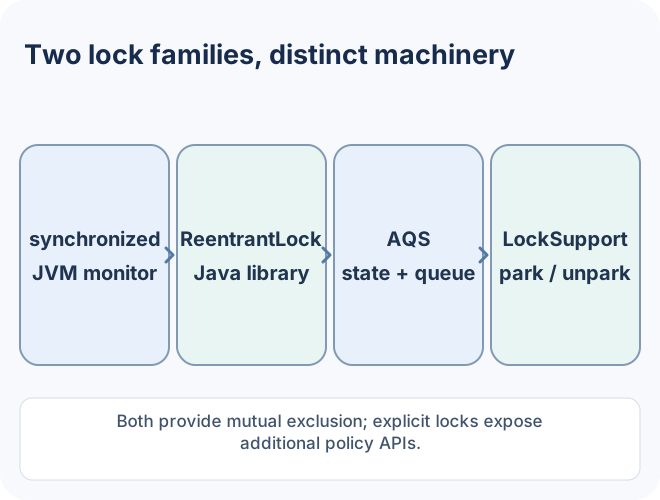
synchronized is a JVM monitor abstraction; ReentrantLock is a Java-library synchronizer built primarily on AQS.
When an explicit lock helps
The simplest case is still a monitor:
synchronized (account) {
    account.update();
}
When the coordination policy is part of the problem, an explicit lock has operations that a monitor does not expose:
if (lock.tryLock()) { ... }                  // do not wait
if (lock.tryLock(100, MILLISECONDS)) { ... } // wait up to a bound
lock.lockInterruptibly();                    // cancellation can stop acquisition
The last form is useful when a task’s cancellation should include time spent waiting for a lock. Code must still release an acquired lock on every exit path:
lock.lock();
try {
    account.update();
} finally {
    lock.unlock();
}
The try/finally is essential. Unlike leaving a synchronized block, returning from a method does not automatically unlock a ReentrantLock.
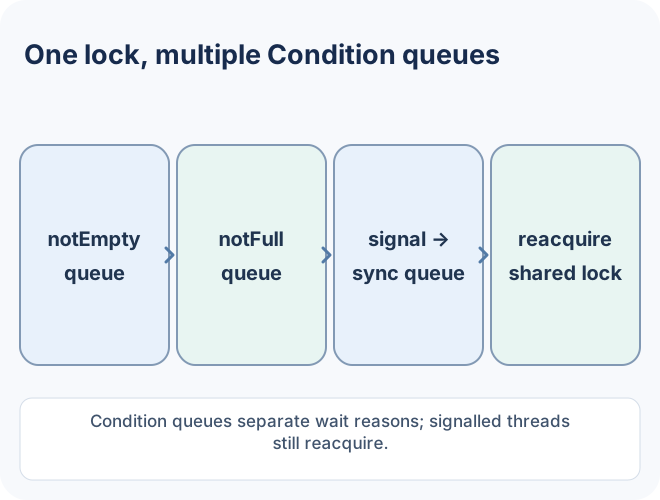
Conditions are another reason to choose this API. One lock can create multiple Condition objects, such as notEmpty and notFull for a bounded buffer. That separates wait reasons that would share one object’s monitor wait set when using wait() and notify().
Some inspection methods report whether the current thread owns the lock, its reentrant hold count, or whether threads appear to be queued. These are observations for monitoring and diagnostics; they are not a safe substitute for acquiring the lock or coordinating application decisions.
AQS separates policy from queue machinery
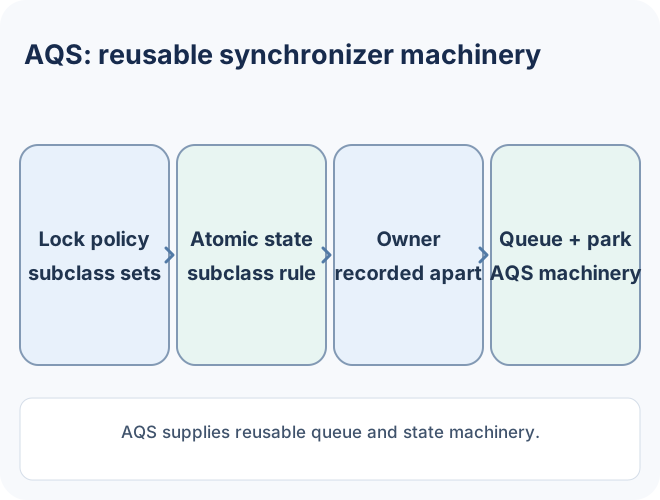
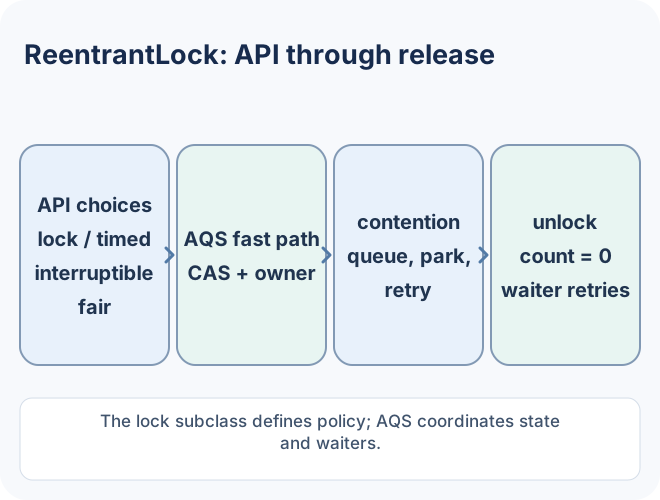
ReentrantLock is built on AbstractQueuedSynchronizer (AQS), a reusable framework in java.util.concurrent. AQS supplies atomic state operations and queueing machinery. A subclass supplies the rules for what that state means and when an acquisition succeeds. AQS is also used by other synchronizers; it is not a synonym for ReentrantLock.
For an exclusive lock, keep three ideas separate:
- State is an integer changed atomically. AQS does not give it one universal meaning. The subclass defines the meaning.
- Owner is the thread that currently has exclusive access. AQS’s ownable synchronizer support lets an exclusive synchronizer record that thread.
- Synchronization queue holds threads that have not acquired and may need to wait. Queue position is not a universal promise of strict first-in-first-out acquisition.
For ReentrantLock, state represents the hold count: zero means unlocked; a positive value counts how many times the owner has acquired it. The exclusive owner is recorded separately. AQS defines no universal meaning for state; the synchronizer subclass does.
The free-lock fast path
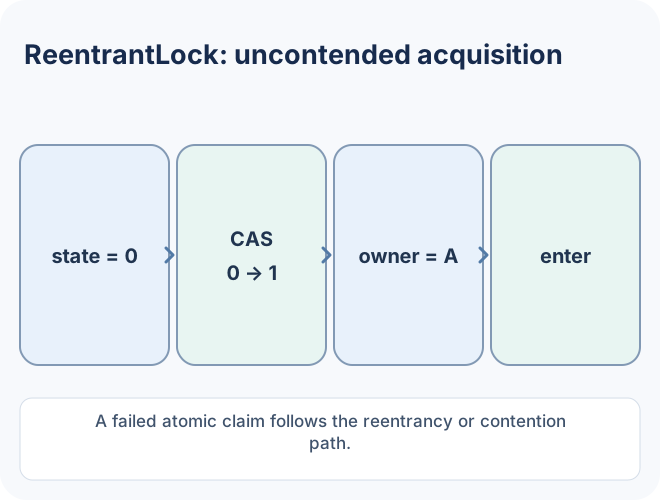
When the lock is free, lock() first tries to acquire without queueing. Conceptually, the non-fair path reads state zero, atomically changes it from zero to one, then records the current thread as owner:
Thread A → attempt acquisition
         → state is 0
         → compare-and-set 0 → 1 succeeds
         → record A as exclusive owner
         → enter critical section
The compare-and-set (CAS) operation succeeds only if state still has the expected value. If another thread wins the race first, this attempt fails and the caller follows a contended path. That atomic transition arbitrates the race; assigning the owner is part of the synchronizer’s protocol.
Reentrancy is a hold count
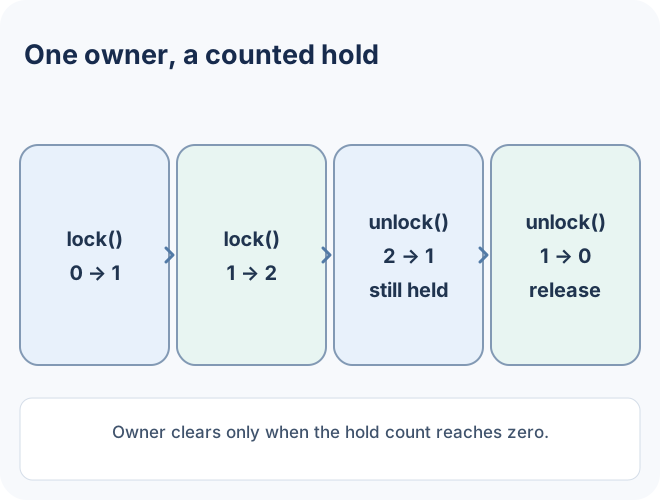
If the current owner calls lock() again, the lock does not deadlock itself. ReentrantLock recognizes the same owner and increments the hold count. Each matching unlock() decrements it. The lock becomes available to another thread only when the count reaches zero; that final release clears ownership and can wake an eligible waiter.
lock()   state 0 → 1, owner = A
lock()   state 1 → 2, owner = A
unlock() state 2 → 1, owner = A   (still held)
unlock() state 1 → 0, owner cleared (now free)
This is the lock’s logical model. The implementation checks ownership before allowing the count to grow and rejects an unlock() by a non-owner.
What happens when another thread arrives
Suppose A holds the lock and B calls lock(). B cannot claim state, so AQS places B in a synchronization-queue node: this is Java library queueing, not HotSpot ObjectMonitor contention. AQS acquisition repeatedly checks whether B is now eligible and whether the subclass’s acquire rule succeeds. If it cannot proceed, B may park instead of burning CPU in a tight loop. When the lock is released, an eligible queued thread is unparked and retries the acquisition protocol.
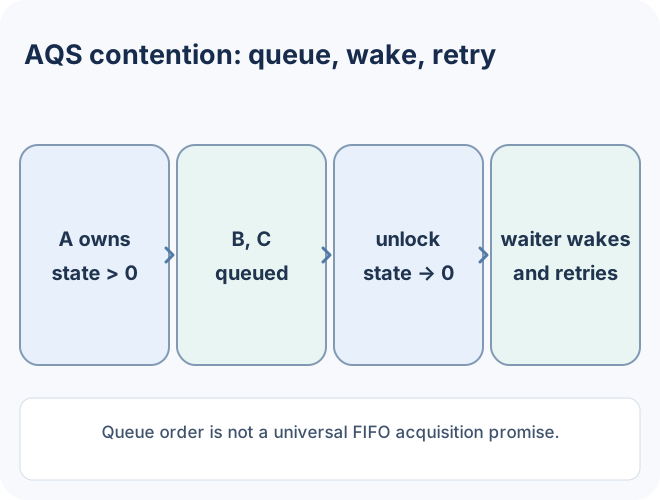
An AQS queue is explicit, but do not read it as a promise that every synchronizer grants access in strict arrival order. The concrete synchronizer chooses its policy; cancellation, wakeups, scheduling, and retry races also matter. ReentrantLock offers fair and non-fair policies, discussed below.
Parking provides a place to wait
LockSupport.park() and unpark(thread) are low-level building blocks used by synchronizers. Each thread has at most one permit. unpark makes that permit available; repeated calls do not stack up multiple permits. If the permit is already available, a later park() consumes it and returns. Otherwise, park() may suspend the thread until an unpark, an interrupt, or another permitted return condition.
That one-bit permit makes the race between “about to park” and unpark safe: an unpark that arrives first is remembered for the next park. But park is not a condition variable and it does not tell the caller that its desired condition became true.
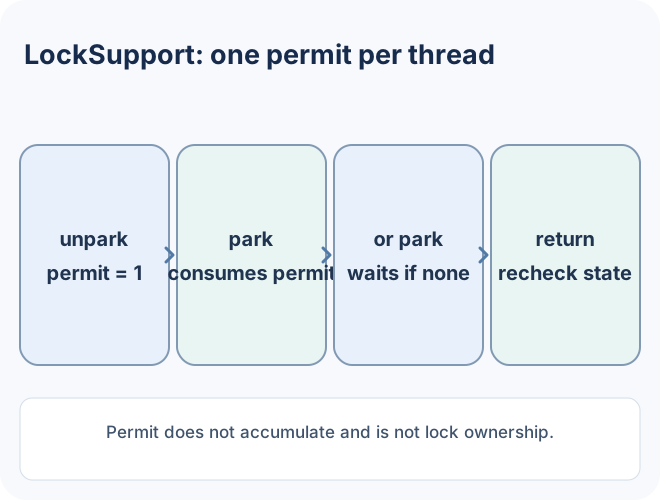
park() may also return spuriously or because the thread was interrupted. Correct synchronizer code therefore loops and rechecks the lock state or other condition after every return. unpark() makes progress possible; it does not transfer lock ownership. The thread still has to run, retry, and win whatever atomic acquisition the lock requires.
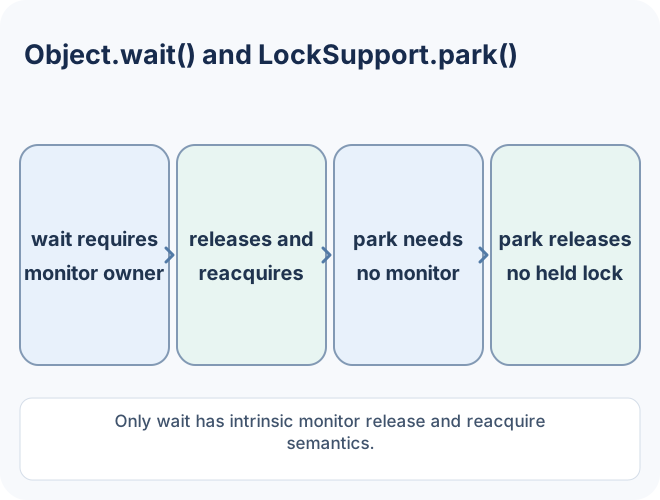
This differs from Object.wait() and notify(). Calling wait() requires owning that object’s intrinsic monitor, releases that monitor while waiting, and reacquires it before returning. LockSupport.park() requires no intrinsic-monitor ownership and does not automatically release any lock the thread holds. AQS or a Condition explicitly arranges the lock state around parking.
Conditions create separate wait queues
A Condition associates a wait queue with a Lock. A lock may have multiple conditions for different predicates. For example, a bounded buffer can keep consumers on notEmpty and producers on notFull rather than waking every kind of waiter for either event.
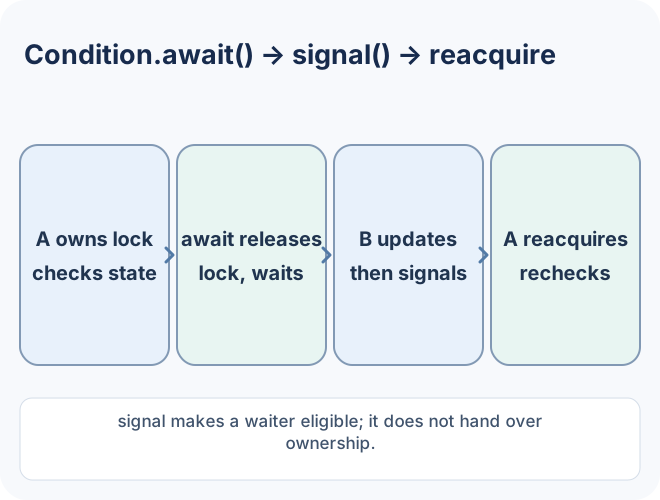
Calling await() requires the caller to hold the associated lock. It atomically releases that lock as it joins the condition queue, then parks until signalled, interrupted, timed out, or otherwise eligible. signal() selects a condition waiter and transfers it toward the lock’s synchronization queue. It does not grant the lock. The awakened thread must reacquire the lock before await() returns, and the program must check its predicate again in a loop.
lock.lock();
try {
    while (queue.isEmpty()) {
        notEmpty.await();
    }
    return queue.remove();
} finally {
    lock.unlock();
}
Use a while, not an if: a wakeup does not prove the predicate is true when this thread reacquires. Another thread may have changed the state first, or the wait may return due to interruption or timeout.
Fairness is an acquisition policy
The default new ReentrantLock() is non-fair. When it becomes free, a newly arriving thread may acquire ahead of one that has waited longer: this is barging. A fair lock favors the longest-waiting eligible thread under contention, which can reduce starvation risk but commonly lowers throughput. Fairness governs lock acquisition; it does not make the operating-system or virtual-thread scheduler fair.
There is a deliberate API wrinkle: untimed tryLock() may barge even when the lock was constructed as fair. It answers whether the lock is available now. The timed tryLock(timeout, unit) honors the fair policy when using a fair lock.
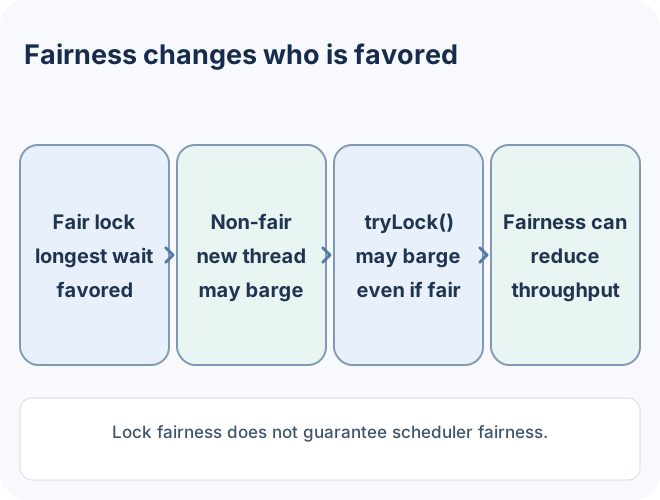
Fairness does not guarantee fair scheduling, and an untimed tryLock() can still barge on a fair lock. Select fairness for a demonstrated acquisition-policy need, then measure its effect under the workload.
What parking means for virtual threads
On JDK 25, LockSupport.park() can suspend a virtual thread through the virtual-thread runtime. In the ordinary case the virtual thread is unmounted and its carrier becomes available to run other work; it is not necessary to keep one operating-system thread asleep for each parked virtual thread. When unpark makes it ready, the scheduler can mount it again. It resumes AQS’s acquisition loop and still has to reacquire the lock.
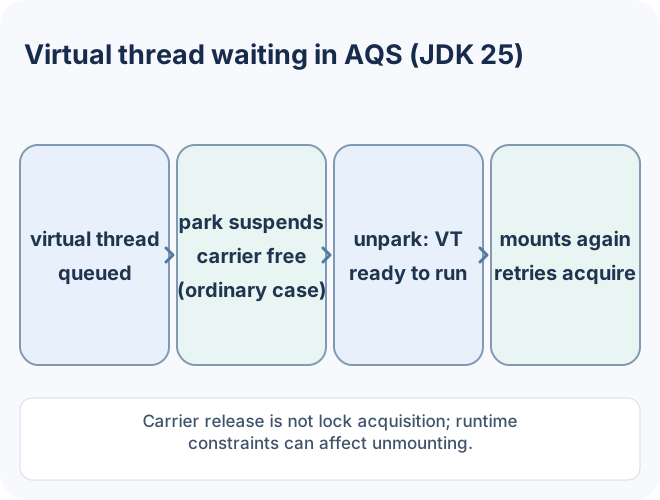
This is a runtime behavior, not a different lock contract: the virtual thread remains a waiter until it successfully reacquires. Native calls and other pinning constraints can affect whether a virtual thread unmounts, so “parked” should not be generalized into “every wait always frees a carrier.”
Diagnose the wait path
Intrinsic monitor entry contention often appears as BLOCKED. Threads waiting through AQS and LockSupport often appear as WAITING or TIMED_WAITING, with stack frames mentioning park, LockSupport, or an AQS acquire method. Conditions can also park while the thread is outside the lock’s critical section.
These patterns help you choose where to look, but a thread state is only a snapshot. It does not identify the lock policy, prove that the wait caused user-visible latency, or measure how often the thread waited. Capture repeated thread dumps during the slow interval, inspect the stack and lock owner, then correlate with JFR or application latency/throughput data. For AQS, look for the application frame above the acquisition or condition wait and determine how long the protected operation takes.
Use ReentrantLock because its semantics fit the coordination problem. It may use a quick atomic path when uncontended, but under contention it still serializes access and incurs queueing, scheduling, wakeup, and cache-coherence costs. No lock API is a blanket performance upgrade.
Check your reasoning
If `unpark(thread)` runs just before that thread calls `park()`, can the wakeup be lost?
For a started thread, the single permit remains available. The next park consumes it and returns. There is only one permit, so repeated unpark calls do not accumulate.
Thread A signals a waiter on a Condition. Does that waiter own the lock when signal returns?
No. Signal transfers an eligible waiter toward the lock's synchronization queue. It must run, reacquire the lock, and check the condition predicate before continuing.
Does a fair ReentrantLock guarantee the thread that arrived first always acquires next?
It favors the longest-waiting eligible thread under contention, but does not control scheduler fairness; untimed tryLock() can barge. Fairness is an acquisition policy, not a universal ordering guarantee.
A virtual thread parks while queued for an AQS lock. Does it stop holding a lock it already owns?
No. Park itself does not release a lock. AQS arranges acquisition parking when the thread does not own the requested lock. A Condition's await() separately releases its associated lock as part of its contract.
Close the synchronization block
The two lock families now have a useful boundary. Intrinsic monitors are part of JVM monitor semantics, with HotSpot managing their representation. ReentrantLock is a library synchronizer: AQS contributes atomic state and waiting queues, while LockSupport provides low-level parking. Conditions add a second kind of queue, and fairness selects an acquisition policy.
The Threads and Synchronization block is complete. Next we return to the heap and begin Garbage Collection foundations: how collectors find live objects, choose what to reclaim, and manage memory over an object’s lifetime.
Sources and implementation boundaries
Based on Daily JVM Byte #21 and its reviewed lesson requirements. The diagrams and acquisition sequences are explanatory; no contention benchmark or forced thread-state experiment was run. Public API behavior is based on Java SE 25 documentation. AQS internals and virtual-thread parking notes describe the OpenJDK 25 implementation and may vary across JDK builds. Thread state is diagnostic evidence, not a complete performance diagnosis.
- Java SE 25 API: ReentrantLock
- Java SE 25 API: AbstractQueuedSynchronizer
- Java SE 25 API: Condition
- Java SE 25 API: LockSupport
- Java SE 25 API: Thread.State
- OpenJDK 25u source: ReentrantLock policy and hold count
- OpenJDK 25u source: AQS state, acquisition queue, and conditions
- OpenJDK 25u source: LockSupport parking integration