You create a short-lived Point, read its fields, and immediately discard it. Lesson 8 showed that a real allocation is often cheap because HotSpot can advance a pointer inside a TLAB. But must the optimized program allocate this object at all?
int distance() {
    Point p = new Point(10, 20);
    return p.x() + p.y();
}
Java source defines the behavior the program must preserve. It does not require every source-level object to survive as a physical heap object in optimized machine code.
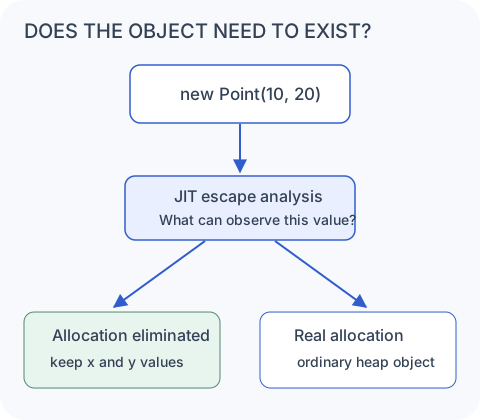
The analysis that creates this opportunity is escape analysis. HotSpot asks how the object can be observed within and beyond the compilation scope. If no external observer needs the Point or its identity, the optimizer may preserve only the values the computation uses.
Scalar replacement preserves values without the object
At source level, Point has an identity, header, and fields. For this computation, the useful state is only x = 10 and y = 20. Scalar replacement decomposes the aggregate into those separate scalar values.
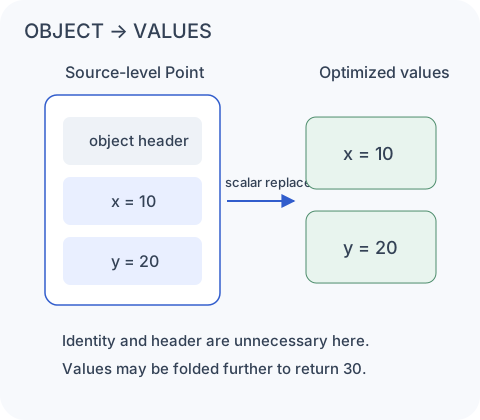
Conceptually, the compiler can move from:
allocate Point
write x and y
read x and y
return x + y
to:
x = 10
y = 20
return x + y
Those values might live in registers, stack slots, or compiler intermediate values. Further optimization may reduce the whole example to return 30.
Escape analysis and scalar replacement are distinct. Escape analysis supplies facts about observability. Scalar replacement is an optimization that may use those facts. Proving sufficient confinement creates an opportunity; it does not guarantee that every NoEscape allocation disappears. Control flow, failed inlining, object identity use, compiler limits, and interactions with other phases can prevent the transformation.
Escape states describe what the compiler can prove
HotSpot uses three useful escape-state categories. They are compiler concepts, not Java-language annotations or promises.
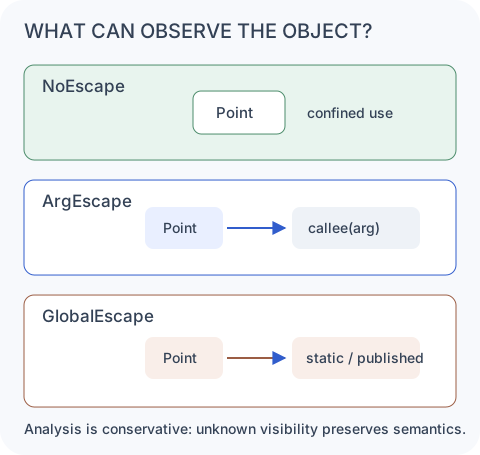
NoEscape: the object stays inside the analyzed work
Our running example creates and consumes the Point locally:
int sum() {
    Point p = new Point(10, 20);
    return p.x() + p.y();
}
If HotSpot sees every use and no operation needs the object’s identity, its conceptual optimized form can be:
int x = 10;
int y = 20;
return x + y;
The second block is an illustration of the compiler’s view, not Java code produced by the JIT. NoEscape makes the allocation a scalar-replacement candidate; it does not guarantee that C2 will remove it.
ArgEscape: the reference passes through a call
Now pass the same temporary to a helper:
int sum() {
    Point p = new Point(10, 20);
    return readX(p);
}

int readX(Point point) {
    return point.x();
}
The reference crosses a method boundary as an argument, but readX does not store or return it. If HotSpot can inspect the call, especially by inlining it, the larger compiler view becomes:
int sum() {
    Point p = new Point(10, 20);
    return p.x();
}
That may expose a NoEscape shape and another scalar-replacement opportunity. If the helper cannot be analyzed or inlined, HotSpot may have to keep the allocation. ArgEscape says where the reference flows; it does not promise either outcome.
GlobalEscape: another scope can keep the reference
Finally, add a write to static state:
static Point current;

int publish() {
    Point p = new Point(10, 20);
    current = p;
    return p.x();
}
The externally visible behavior now includes:
allocate Point
store reference in static current
Point remains available
after publish() returns
Replacing the object with a local x value would lose the object stored in current, so this straightforward allocation cannot disappear. Storing into an already escaping object can create the same effect.
These categories are conservative analysis results. When the compiler cannot prove that an object stays confined, it preserves the full Java object semantics.
Inlining expands the scope of escape analysis
Returning an object from a Java method does not always mean it escapes the optimized compilation. Consider a factory call:
Point createPoint() {
    return new Point(10, 20);
}

int calculate() {
    Point p = createPoint();
    return p.x();
}
Analyzed in isolation, createPoint() returns the object. If the JIT inlines that method into calculate(), allocation and consumption become visible in one larger scope.
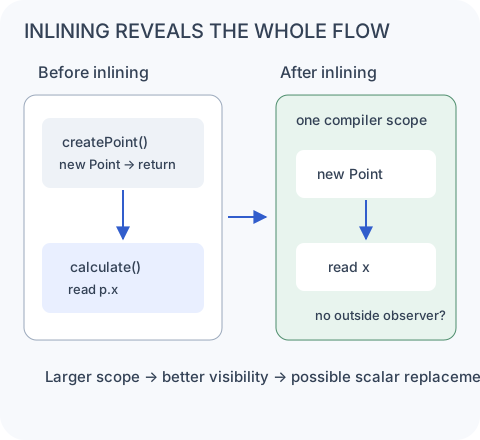
Inlining therefore improves the opportunity for escape analysis by giving it more code to inspect. It still does not guarantee scalar replacement: the compiler must support the resulting object and control-flow shape.
Scalar replacement does not move the object to the stack
It is tempting to picture escape analysis like this:
the Point does not escape
        ↓
put the Point on the stack
But HotSpot usually takes a different route. If scalar replacement succeeds, there is no Point object to move. The compiler keeps only the values that the calculation needs.
Start with the source:
Point p = new Point(10, 20);
return p.x() + p.y();
The optimized computation may be closer to:
int x = 10;
int y = 20;
return x + y;
The object header, the reference p, and the Point container are absent. This is allocation elimination, rather than moving an intact object to another memory area.
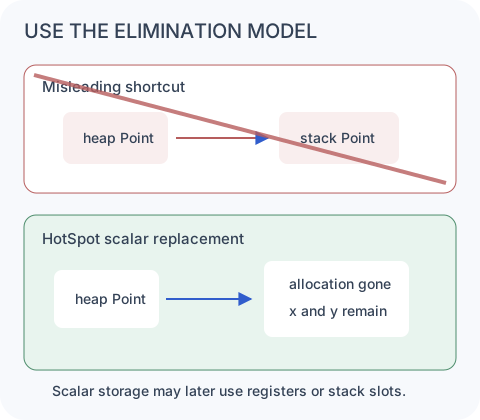
The scalar values x and y may later occupy CPU registers or stack slots. That only describes where individual machine-code values are stored. It does not mean a complete Point, with an object header and identity, was allocated on the stack.
A private lock may become unnecessary
Escape analysis can also enable lock elimination. Suppose a method creates a fresh lock and synchronizes on it:
void calculate() {
    Object lock = new Object();
    synchronized (lock) {
        doWork();
    }
}
If HotSpot proves that no other thread can observe lock, no other thread can contend on its monitor. The monitor enter and exit are then unobservable coordination, so the compiler may remove them while preserving the work.
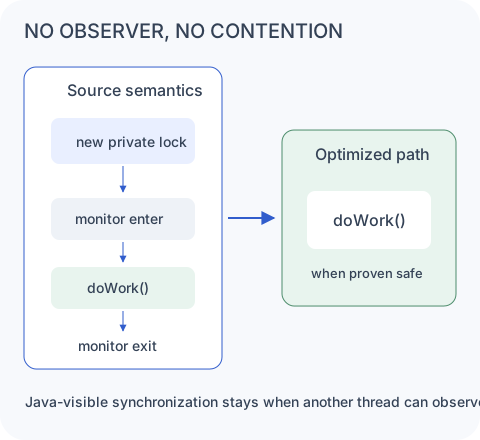
This is a compiler optimization, not a relaxation of Java synchronization rules. If another thread could observe the monitor, the required ordering and mutual exclusion must remain.
Deoptimization can materialize Java-level state
An eliminated object raises a natural question: what happens if HotSpot later invalidates an assumption and deoptimizes the compiled code?
Optimized code retains metadata describing the Java-level state needed at deoptimization points. If execution returns to a less optimized form, HotSpot can reconstruct, or materialize, a scalar-replaced object from its saved field values when that object is required.
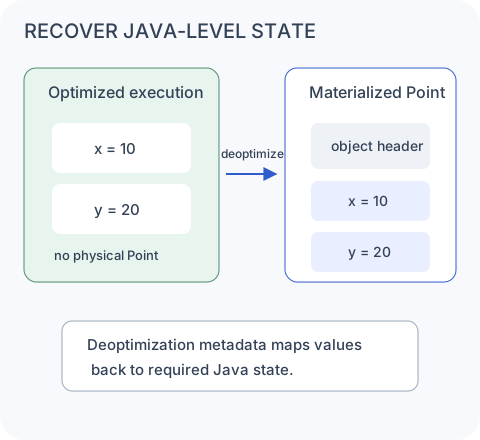
This is only the intuition; a later JIT lesson can follow speculative assumptions and deoptimization in detail. The useful principle here is that optimized representation may differ sharply from source representation while observable semantics stay intact.
Source-level new is not an allocation counter
Consider a loop containing one million new Point(...) expressions. The source describes one million object constructions, but some optimized executions may need fewer real heap allocations.
int count = 1_000_000;
int i = 0;
while (i < count) {
    Point p = new Point(
        i, i + 1
    );
    result +=
        p.x() + p.y();
    i++;
}
The actual outcome depends on compilation and runtime context. Before warmup, interpreted or less optimized code may allocate. Later compiled code may eliminate an allocation. A profiler observing real allocation activity therefore reports runtime behavior, not a count of source-level new expressions.
This also makes allocation microbenchmarks easy to misread. If a hand-written benchmark creates a value whose result is unused, dead-code elimination may remove the intended work. JMH provides warmup, measurement structure, state controls, and mechanisms such as consuming results, but using JMH alone does not make a benchmark valid. The benchmark must still ensure that it measures the behavior in question and inspect generated or profiled evidence when the distinction matters.
Write clear code, then measure the optimized program
Escape-analysis outcomes can change with inlining, call structure, polymorphism, control flow, identity-sensitive operations, compiler visibility, and optimization budgets. There is no dependable source-level recipe that forces scalar replacement.
Write the clearest correct code first. When allocation or locking appears important in production, profile the warmed-up workload, compare allocation and GC evidence, and change application structure only when measurements justify it. Manually avoiding every temporary object can make code harder to maintain while targeting an optimization the compiler may already perform.
Check your reasoning
Suppose C2 fully analyzes this method, proves that Point does not escape, and determines that its identity is irrelevant:
int value() {
    Point p = new Point(10, 20);
    return p.x();
}
Does HotSpot need to create an intact Point on the stack?
Pause here, then check your reasoning
No. Scalar replacement can eliminate the aggregate allocation and retain only the values required by the computation. Those values may occupy registers or stack slots, or disappear through further optimization. NoEscape creates this opportunity; it does not promise that C2 will always perform the transformation.
Now change the method so it stores p in a static field. What changes?
Check the observability boundary
The reference becomes globally observable, so HotSpot must preserve the Java object semantics. That blocks this straightforward scalar-replacement case. A real allocation can still take the cheap TLAB path when it fits; escape analysis and TLAB allocation answer different stages of the decision.
Put the allocation decision together
The allocation story now begins before the TLAB fast path. The JIT first decides whether a separately allocated object is required. If scalar replacement is possible, the values continue without a normal heap allocation. Otherwise, ordinary allocation proceeds through a TLAB when suitable, or through collector-specific outside-TLAB machinery. The resulting heap object enters the collector’s lifecycle and may later contribute to GC work.
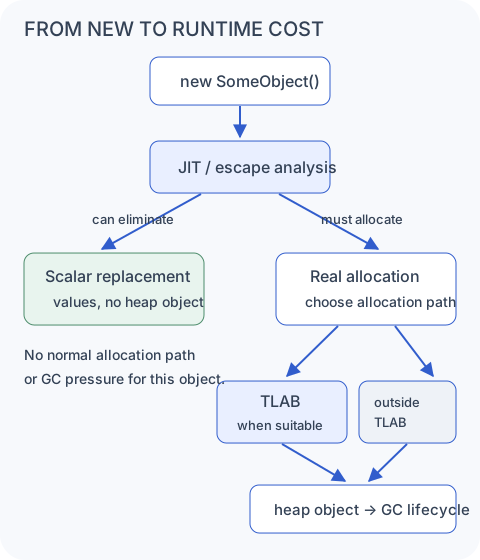
The next preview follows a different transition: the class-loading lifecycle, from class-file bytes through loading, linking, verification, preparation, resolution, and initialization.
Sources and implementation boundaries
Adapted from Daily JVM Byte #9 and its reviewed draft. Transformations and diagrams are conceptual rather than measured output. Claims describe HotSpot C2 behavior and limitations, not requirements imposed on every JVM implementation.
- Oracle JDK 25: escape states, scalar replacement, no general stack allocation, lock elimination, and inlining example
- OpenJDK: HotSpot escape-analysis and scalar-replacement limitations
- OpenJDK JDK 25: reconstructing scalar-replaced objects during deoptimization
- OpenJDK JMH samples: dead-code, blackhole, state, and compiler-control examples